
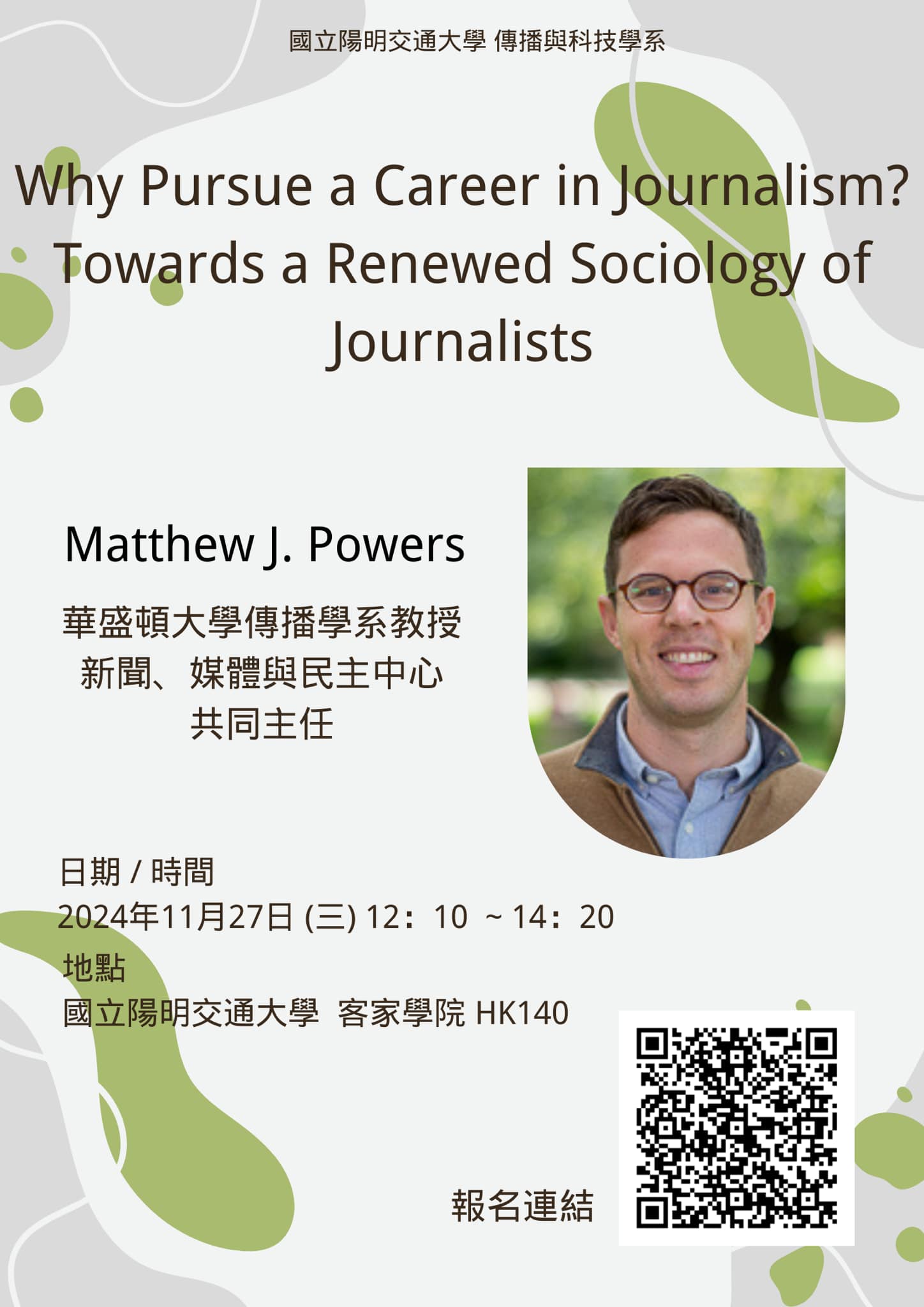
University of Washington|Prof. Matthew J. Powers’ Talk: Why Pursue a Career in Journalism? Towards a Renewed Sociology of Journalists
Speaker: Prof. Matthew J. Powers
Date & Time: Wednesday, November 27, 12:10 – 14:20
Venue: Room HK140, College of Hakka Studies, National Yang Ming Chiao Tung University
Matthew J. Powers is a Professor in the Department of Communication at the University of Washington (Seattle) and Co-Director of the Center for Journalism, Media, and Democracy. His research and teaching focus on comparative media, qualitative research methods, and the sociology of journalism.
Prof. Powers is the co-author of The Journalist’s Predicament: Difficult Choices in a Declining Profession (Columbia University Press, 2023), co-editor of Rethinking Media Research for Changing Societies (Cambridge University Press, 2020), and the author of NGOs as Newsmakers: The Changing Landscape of International News (Columbia University Press, 2018).
This talk begins from the premise that journalism scholars are poorly positioned to answer a question of fundamental relevance: why anyone would bother being a journalist, given the low wages, uncertain career prospects and diminished prestige associated with the profession. Professor Powers first outline the habits of mind that prevent scholars from asking this question or lead them to provide answers that repeat journalistic common-sense. Then, he will propose a renewed sociology of journalists that centers the cultivation, management, and—for some—cessation of the belief that a career in news is worthy of one’s investments, highlighting the structuring force of social backgrounds, personal trajectories and national contexts in shaping who becomes a journalist and on what terms. Finally, Professor Powers will link the plight of journalists to threats confronting a host of socially important jobs like nursing, teaching and caretaking, which drawing on Weber (1919) he considers as vocations. The broadest utility of this approach, he suggests, is the formulation of a research agenda that asks about the terms under which contemporary vocational commitments are made, by whom, and with what implications for both these jobs and the societies in which they are embedded.